How did life emerge on Earth? Are we the only ‘living’ planet in the universe? How can something as fragile as a living organism colonize an entire planet? Do all living beings on our planet descend from one and the same common ancestral cell?
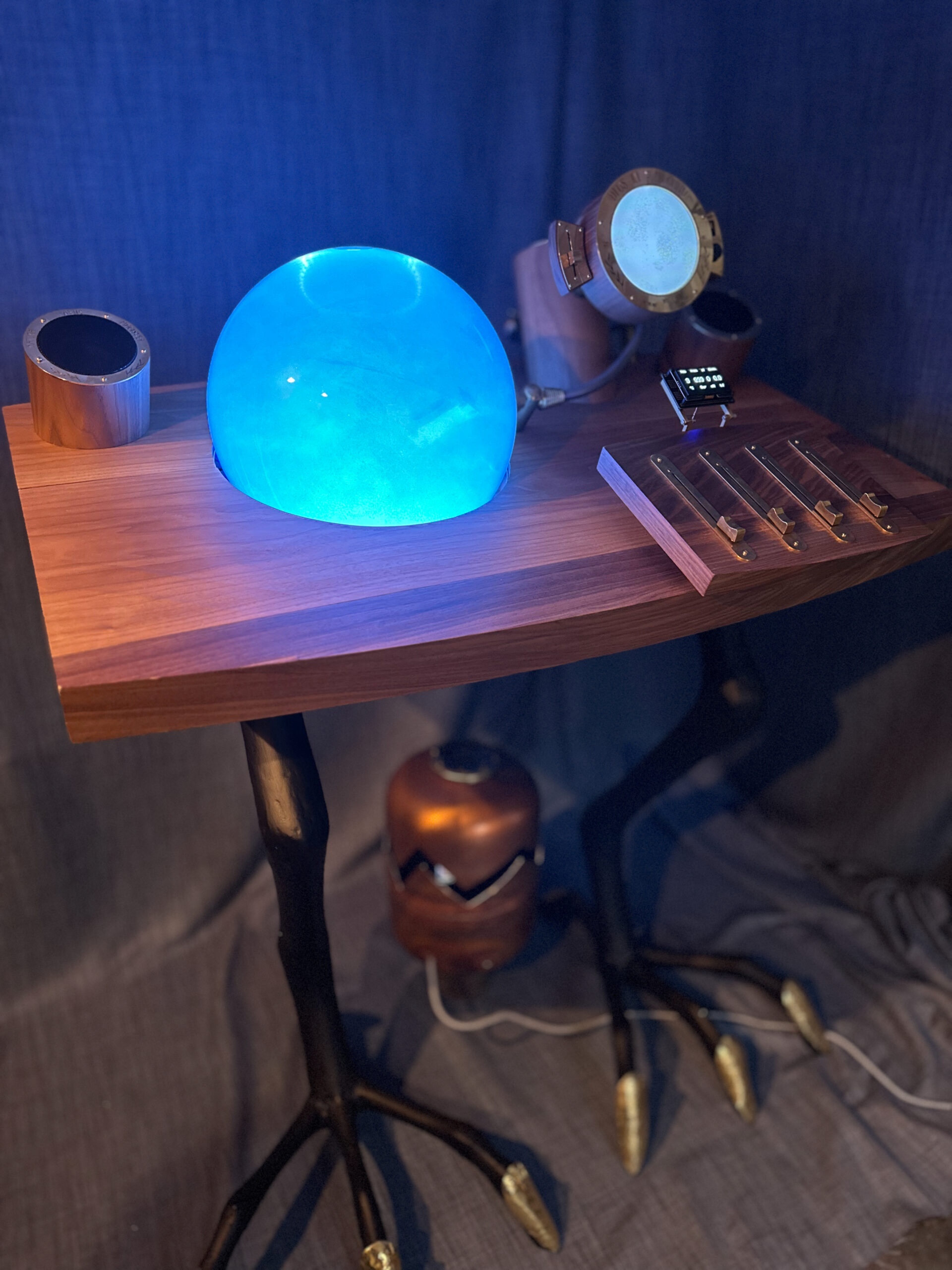
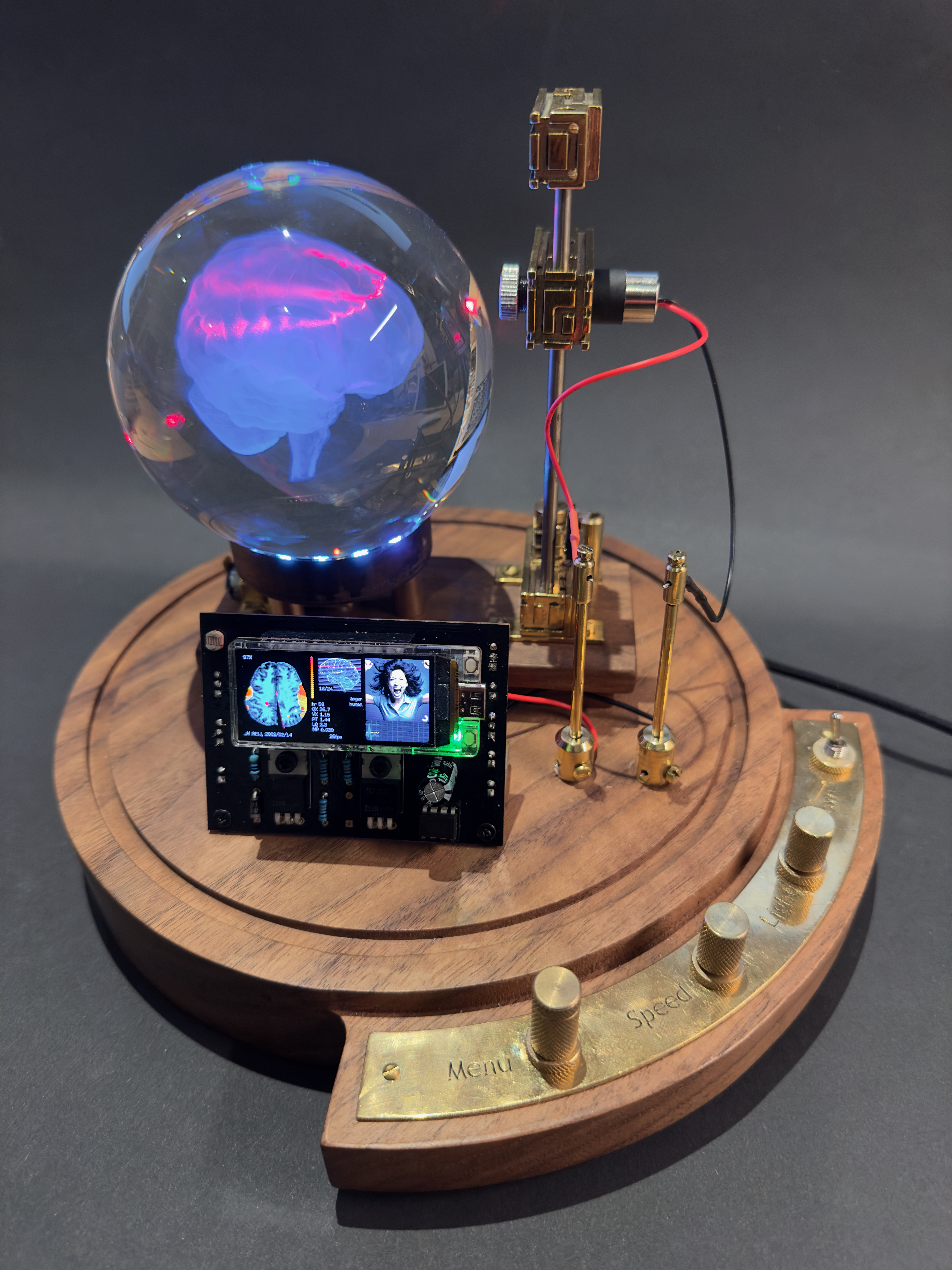
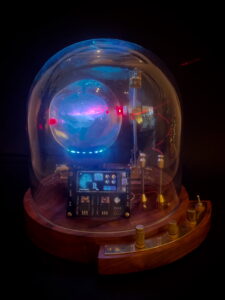
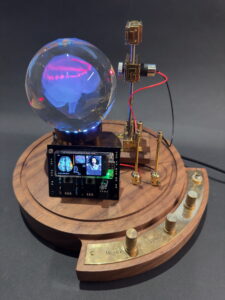
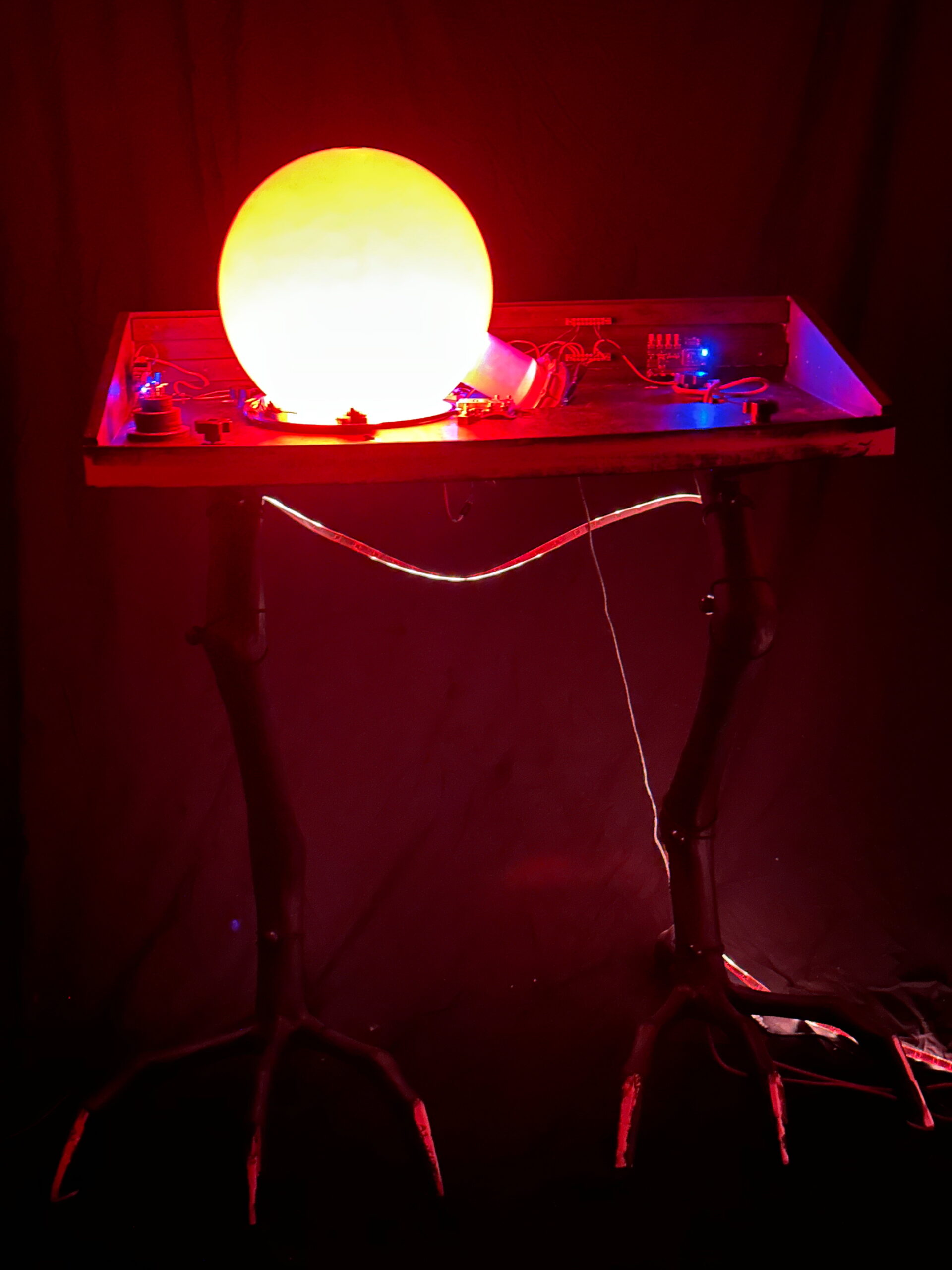
An elegant installation of brass and American walnut stands on large black bird legs. Beautifully finished. The big glass sphere displays a turbulent ‘primordial soup’. Blue when cold, red when overheated.
The microscope shows what is happening inside the sphere. Four large sliders beg to be moved.
The Origin of Life takes you back 4 billion years, when the first life originated on Earth. Now it is up to you to create the right conditions…
Simulation
Here you can experiment with the Origin of Life simulation yourself:
Hydrothermal vents or tidal pools?

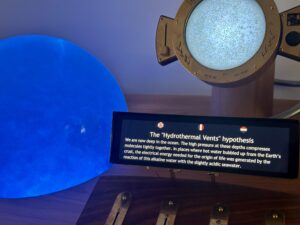
We know little for certain when it comes to something that happened 4 billion years ago. There are no clear theories explaining how the first life originated and where it happened. There are only ‘hypotheses’: possibilities. Currently, the “hydrothermal vents” hypothesis is the most prevalent in science, followed by the “tidal pools” hypothesis.
The Origin of Life lets you experiment with both possibilities: either at the sea surface near the coastline or deep underwater at the hot springs on the seabed. If you manage to get the conditions right, you see how molecules clump together into intricate constellations with a cell membrane and often specialized regions as well. But whether that is already life remains an open question.
Science Communication
The Origin of Life encourages visitors to actively reflect on a complex issue such as the origin of life, which took place on a timescale unimaginable to us. These are some of the recurrent themes in my conversations with visitors:
- When is something alive?
- What does a transition from ‘lifeless’ to ‘living’ look like? What was required for it?
- Did life emerge once and are we the result of that? Or did it happen billions of times and fizzled out billions of times?
- Why are scientists fairly certain that all life on Earth originated from one and the same ancestral cell?
- What would other, earlier forms of life have looked like?
- What changes has Earth undergone caused by all living organisms?
- What are the consequences of climate change for life on Earth?
- If there are billions of stars, each with many more planets, surely there must be one somewhere that is reasonably comparable to our planet?
- If we already find complex molecules, such as amino acids, on asteroids passing by by chance, what does that mean for the chances that there is life somewhere outside of Earth?
It’s not always easy to start a conversation with the wider audience, but the Origin of Life strikes a chord with every visitor: this has no resemblance to anything we encounter in daily life, so it must be interesting! And once engaged, the subject of the emergence of life turns out to be remarkebly fascinating for many people.
Origins Center
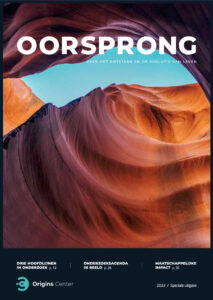
In the Netherlands we do a lot research into the origin of life. The Origins Center is the umbrella organization for the more than 380 Dutch researchers in this field: biologists, geologists, mathematicians, chemists, and astronomers. They have compiled a very nice, accessible brochure: Oorsprong.
On May 19, 2026, I presented my Origin of Life at the annual conference of the Origins Center in Kerkrade. To my surprise even serious researchers are enthralled by my unique visualization of their field.